Bookmark and Share

Thursday, August 26, 2010

Penglai Pavilion

Perched on the Danya Mountain of southwestern Penglai County, the Penglai Pavilion occupies 3.38 hectares, and is shaded with green pines and verdant cypresses. Near to the sea, it is always shrouded by the cloud and mist, and thus the pavilion is called the fairyland on earth. Moreover, the legend and myth of the First Emperor of Qin searching for immortals and elixir as well as the eight immortals crossing the sea increase much mystery for the pavilion.


Built during the Northern Song Dynasty, the Penglai Pavilion has existed for over nine hundred years. In the following dynasty since its debut, the pavilion had been enlarged and repaired to reach the current state. As a magnificent architectural complex of temple and gardens, the pavilion consists of some palaces, halls and temples. When climbing it, if you are lucky, you may watch the wonderful mirage.

Thursday, June 17, 2010

Visions of immortal life in Penglai


Summer is the season for mirages in Penglai. Strange things have been seen rising from the water during the hotter months in this coastal city on the northern tip of Shandong Province.

The most recent full-scale apparition of the famous Penglai mirage may have been on Sunday, May 7, 2006. A report in the China Daily declared, "Rare Mirage Appears off East China Shore," and explained that "mists rising on the shore created an image of a city, with modern high-rise buildings, broad city streets and bustling cars as well as crowds of people all clearly visible." It was estimated that 30,000 people flocked to Penglai. The illusion was widely photographed and videotaped.


The Penglai mirage is one of the world's most frequently-occurring cases of fata morgana, a kind of optical illusion in which layers of mist at varying temperatures refract light in such a way that remote objects like buildings, cars and mountains are temporarily projected and magnified on the horizon from various directions.


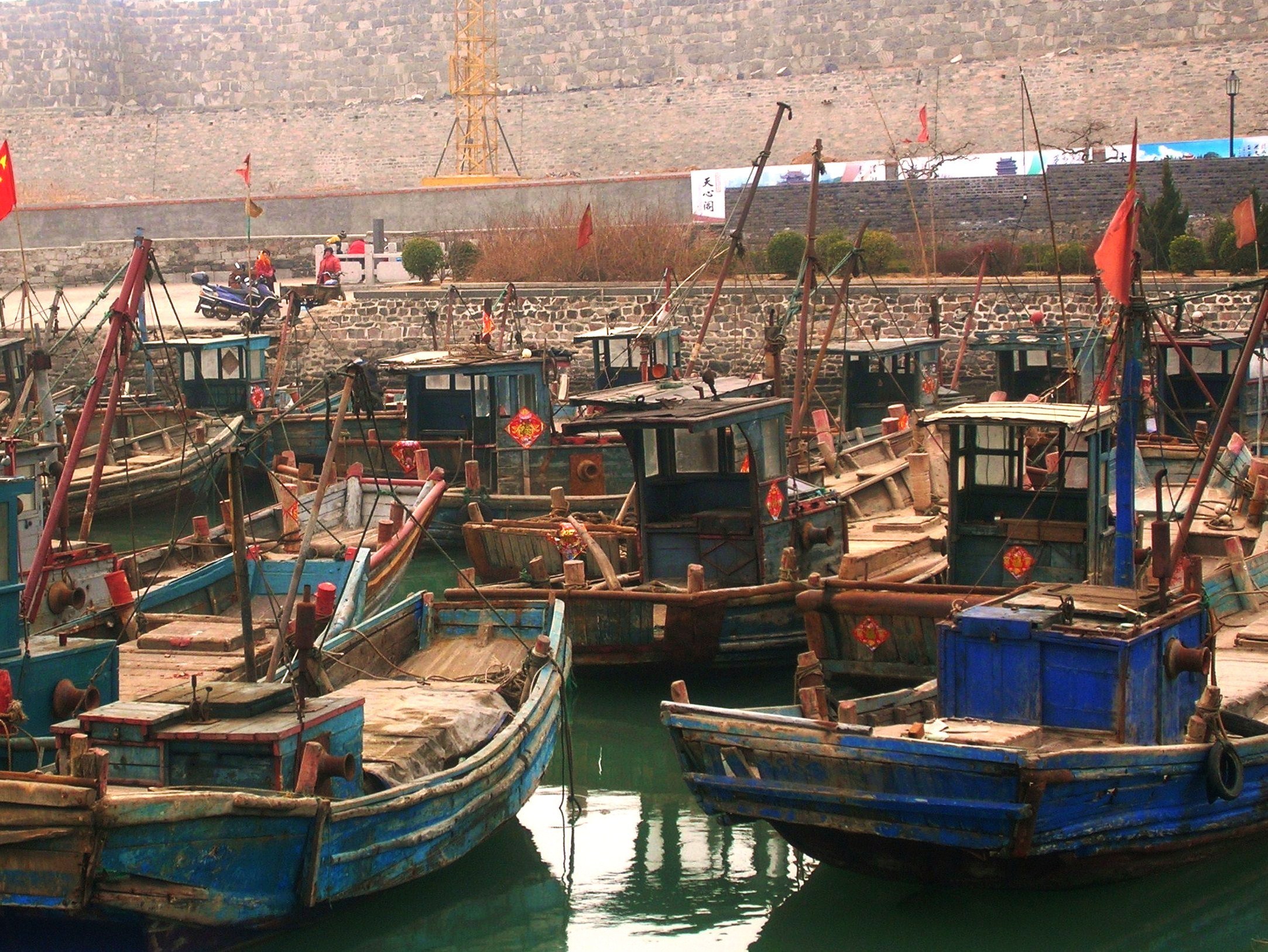
Wooden fishing boats docked in an inlet in Penglai. [Photo by Mark Frank]


Perhaps it is because of its frequent mirages that Penglai has been enveloped in folklore for thousands of years. It is often described as a "fairyland of the world." This is a translation of the Chinese phrase "renjian xianjing," which might be better translated into English as "place of immortals among humans."

In a way, Penglai represents to the Chinese what the Fountain of Youth represents to the western world: the futile quest for immortality on earth. The first emperor of China, Qin Shihuang, reputedly came here to launch an expedition in search of the elixir of life. He believed that the elixir was to be found on a sacred island off the coast near Penglai that may or may not have been a mirage. The sailors that he commissioned blamed their failure to obtain the elixir on vicious sharks, and the devastated emperor is said to have wandered up and down the coastline firing at sharks with a crossbow in revenge.

The great poet, politician and calligrapher Su Dongpo also sought immortality in Penglai more than a thousand years later. One version of his legend says that while wandering the streets of Penglai as prefect of Dengzhou during the Song Dynasty he saw a man whom he believed to be Lü Dongbin, one of the eight immortals of Taoism, because the openings on the receptacles that the man carried formed the shape of his name. Su Dongpo then followed the eight immortals, disguised as beggars, to the top of a pavilion where they enjoyed a drunken feast and then set off on a fantastic journey across the ocean, wielding their magical weapons to cross over the water. Su begged them to take him along as the ninth immortal, and although they yielded to his request he ultimately lacked the courage to leap out onto the water.

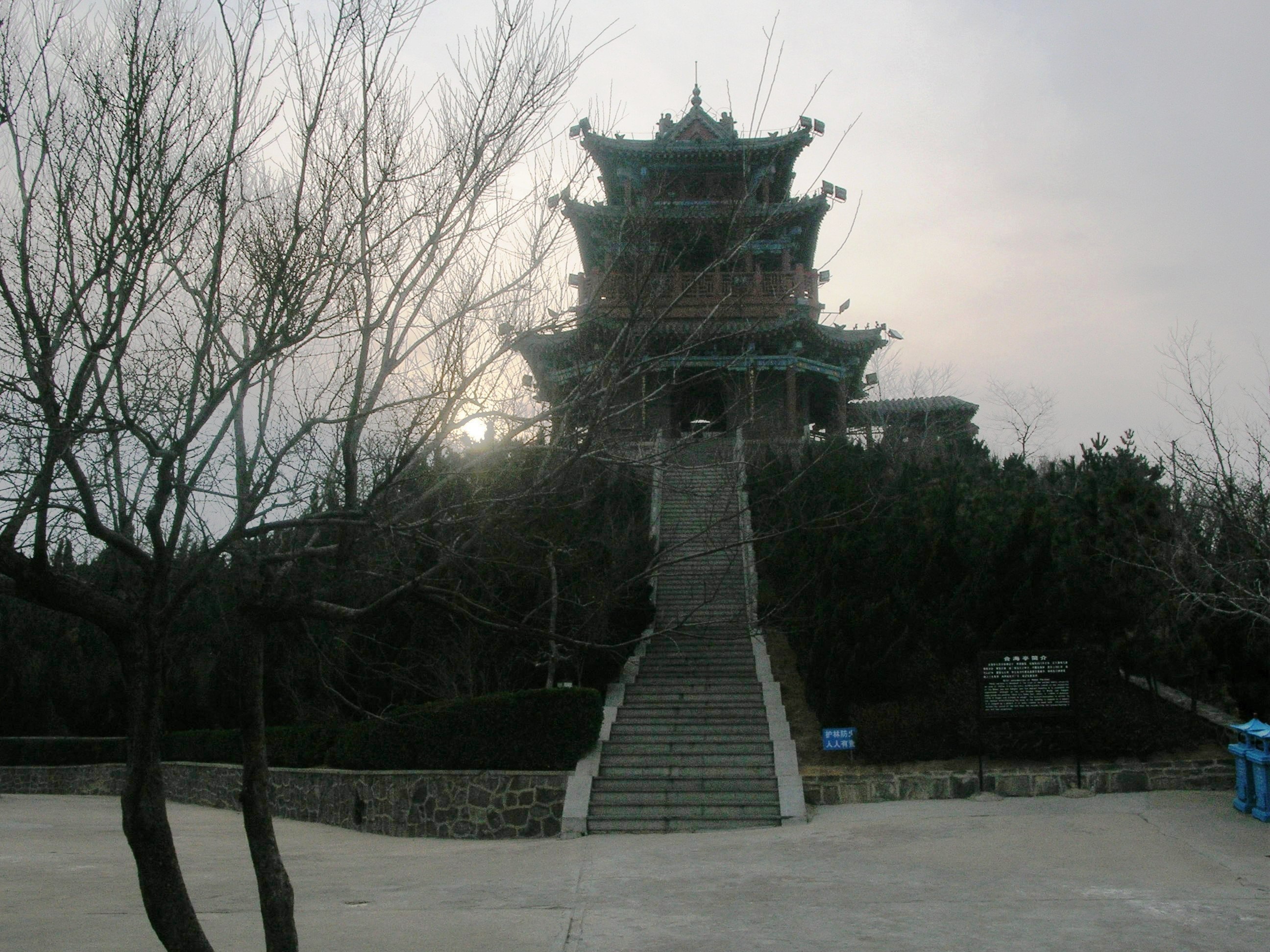
Hehai Pavilion marks the point where the dragon spirits of the Bohai Sea and the Yellow Sea meet. [Photo by Mark Frank]

There is more than just folklore in Penglai. For nearly 500 years it was a fairly illustrious city, divided into two parts by a moat and walls. The southern section of the city has now been replaced by modern architecture, but parts of its sea-hugging northern section have been preserved. Most impressive is the assortment of sites known as Penglai Pavilion, which borders on the ocean at the point where the Bohai Sea meets the Yellow Sea. It is a castle-like assortment of parapets, pathways and pavilions that cling to the cliffs.

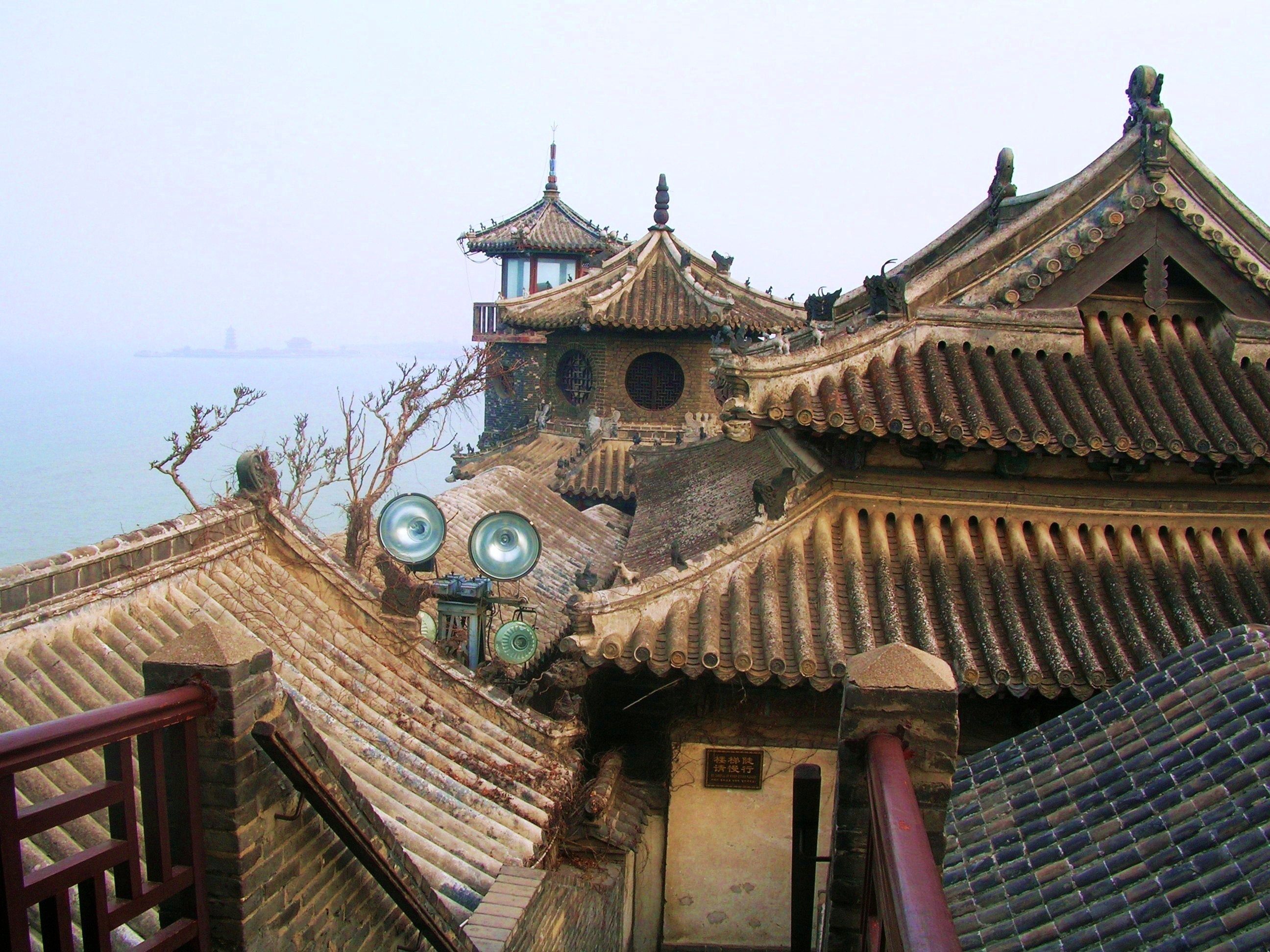
One of the many old complexes in Penglai Pavilion. [Photo by Mark Frank]


Ida Pruitt, a daughter of American missionaries who grew up in Penglai, wrote that "two thousand years of stories and legends cling around the gray walls. It has been a city of great deeds but even more has it been the home of great men who have gone elsewhere for their great deeds."

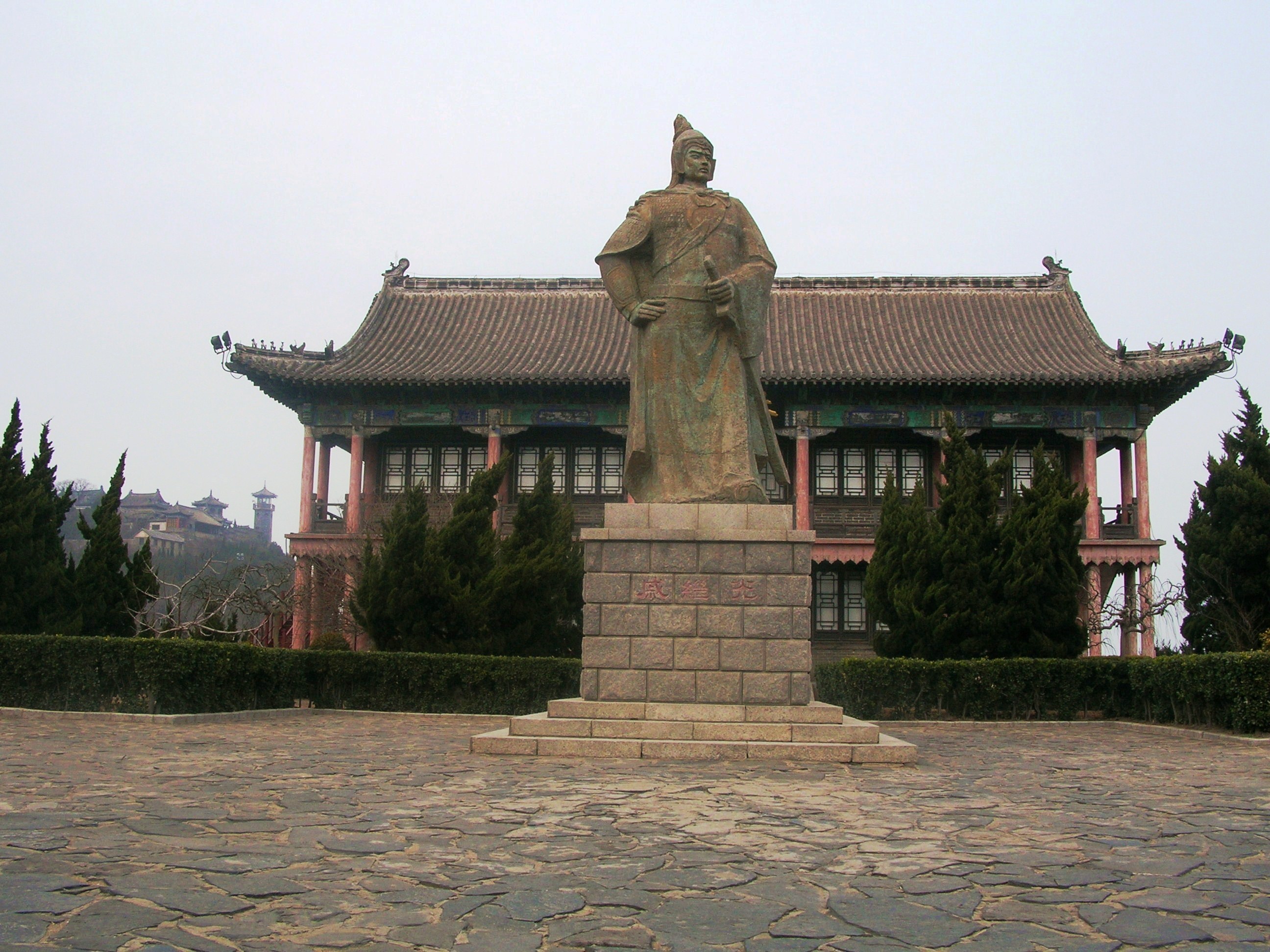
Su Dongpo was one such man. Another was Qi Jiguang, the pirate hunter. During the Ming Dynasty, Penglai was a well-defended harbor with its own fleet of military junks. Qi cut his teeth as a military commander by battling Japanese pirate ships from Penglai as a high-ranking naval officer. He would later move to Zhejiang and eradicate most of the pirates of southeastern China, then battle the invading forces of Altan Khan in the north. There is now a statue of Qi Jiguang at Penglai Pavilion to commemorate his tenure there.
Adjust font size:

A statue of Qi Jiguang, the Ming Dynasty pirate hunter, in Penglai. [Photo by Mark Frank]

During the nineteenth century steamships replaced sail-powered ones and Penglai sank into virtual obscurity as most marine activity moved to the nearby deepwater port of Yantai. Today Penglai is a welcome escape from the crowds that smother some of Shandong's other attractions. If you're tired of looking for a place to lay down your beach mat in Qingdao or dodging peddlers and pilgrims at Taishan, you will probably appreciate the relative serenity of Penglai's coastline.

Visitors to Penglai should travel to the city of Yantai and catch a minibus from there to Penglai's bus station. Travel between Yantai and Penglai takes a little over an hour. Penglai Pavilion (Penglai ge in Chinese) is within walking distance from the bus station, and you should ignore the hoard of pedicab drivers that mass around the bus station. Once you are inside the walls of Penglai Pavilion, the peddlers and pedicabs will mostly disappear.

A good day or two can be spent climbing the various pavilions, inspecting the ramparts and museum exhibits (including the recovered hull of a centuries-old junk) and admiring Su Dongpo's immaculate calligraphy. Because of its association with the Eight Immortals, Penglai is also a sacred site in Taoism and has a rich assortment of temples dedicated to Taoist deities.

And if you visit during the summer, keep your fingers crossed for a mirage sighting as you stroll along the small quartz-strewn beach at the foot of the cliffs.

Friday, July 24, 2009

Leopard Sharks in Penglai Ocean Polar World

Seven leopard shark pups eggs hatched successfully in Shandong Penglai Ocean Polar World.

The female leopard shark lays eggs inside her body and the shark pups are born when the eggs hatch inside of her. A leopard shark can give birth to a litter of four to 30 pups at a time!


Leopard sharks grow slowly, taking ten years to reach maturity.

The small sharks are all the normal physical condition since their birth this month and show no adverse signs.

The breeders will pay close attention to the pups and study the marine animals to gain more experience.


Thursday, March 5, 2009

Treasures to be found in Penglai


According to the Penglai city news, a few days ago, construction workers at a pipeline construction site found in the mud of the sea at 1.1 meters deep, a 7 meters long Ming Dynasty berm.
Specialised heritage workers then cleared the scene and found about 40 root wood piles and more than 56 Ming Dynasty blue and white tablets.


Those pictures do not represent ones that have been found, but only for purpose of information.

Some wood is supposed to be from the Huai, the rest are from the South. The cups and bowls are in blue and white, decorated with characters from the "Chenghua-reign" and also other words and animals. The specialised workers believe the porcalain is from the Ming Dynasty and the building materials from the South.

Monday, November 10, 2008

Some Historical facts about Penglai

The Penglai Water City is located in the east foot of Danya Mountain in the north of Penglai County, Shandong Province.
The Penglai Water City, also called Beiwo City, was a fortress of coastal defense and a hinge of sea transportation. Facing the sea and learning against the mountain, the water city has a precipitous cliff, which makes it a natural barrier itself. The city became a military stronghold in the Han Dynasty (206BC-220AD) and the Tang Dynasty (618-907). Establishments for coastal defenses were built in the second year (1042) of the Qingli reign of the Northern Song Dynasty (960-1127). The water city was built in the ninth year (1376) of the Hongwu reign of the early Ming Dynasty (1368-1644); military headquarters against Japanese was established in the sixth year (1408) of the Yongle reign. Established in the twenty-fourth year (1596) of the Wanli reign, Chief Department of War Inspection (a governmental department in ancient China) governed the affairs about the fight and the coast defense of Shandong Province and concurrently managed the sea transportation. Qi Jiguang, a famous anti-Japanese general, used to lead the navy and prepare for the battle against Japan here. A large number of troops had been stationed here in the early Qing Dynasty.
Having a perimeter of 2,200 meters, the water city was built of mixed earth and stones, with a rectangle plane. The only two doors open are the south door and the north door. The former is a land door leading to a land route. The latter is a water door leading to the sea. Located in the center of the water city, Xiaohai (small sea) has a rectangular plane, with a length of 655 meters from south to north, and splits the city into two parts, east part and west part. Occupying half of water surface, it is a main construction in the city and is for berthing ships and training the navy. In its flourishing age in the Ming Dynasty, there are waterside pavilions dotting the bank, with music and songs all through the night. Several establishments for war were built inside and outside the water city, such as docks, anti-wave platforms, wave-preventing dams, navy encampments, lighthouses, emplacements, fight platforms, water gates and moats, etc, which form a precise sea defense system that holds an important place in the history of Chinese seaport architecture.

The Penglai Pavilion is located on the top of Danya Mountain in the north of Penglai County, east of Shandong Province.

The buildings of the Penglai Pavilion are high up in the air, with cloud and mist around, making it look like an Asgard or a jade pavilion. Stepping on and looking around the mountains and islands, one can see unbounded sea with water and sky in the same color, illusively; the wonder of mirage appears often. This is the famous Penglai fairyland in ancient stories. The Penglai Pavilion was first built in the Jiayou reign of the Northern Song Dynasty and latter expanded in the Ming Dynasty. It has a double-eave gable and hip roof and is 15 meters tall with cloister around. On its top hangs a stele with the name of the pavilion written in golden letters by Tie Bao, a calligrapher of the Qing Dynasty (1644-1911). There are several constructions in the south of the pavilion, such as the Sanqing Hall, the Luzu Hall, the Tianhou Palace, the Longwang Palace, the Guanlan Platform, etc. These buildings feature a compact layout.

Penglai Mountain is one of the three immortal mountains (Penglai, Fangzhang, Yingzhou) of Taoism. According to the historical record, when the Great Yu came here to control the floods, he worshipped the God in the cave and credited the water control to the empyrean. Later, Qin Emperor Shihuang, Han Emperor Wudi also sought gods here for pills of immortal. Assigned by Qin Emperor Shihuang, Xu Fu, an alchemist in the Qin Dynasty (221-206BC), set sail here to seek gods but never returned. The Guanlan Pavilion is located in the southeast of the Penglai Pavilion. Viewing the sea scenery and the sunrise in the pavilion is full of sentiment. Below the cliff of the Guanlan Pavilion is the old water city, where Qi Jiguang, a national hero, used to direct the navy drilling for the fight against Japanese invasion. The Penglai Pavilion has been a conglomeration place for literators and scholars since long before. More than 200 inscriptions for sea viewing and notes in past dynasties were preserved there now.

Monday, July 21, 2008

Spectacular thick fog in July

Penglai, a coastal city in east China’s Shandong Province, is blanketed in thick fog.

The spectacular scenery should have appeared in the morning of July 14th, 2008, following youuchina blog.